NGO PR in Bangladesh turns programme results into credible stories in Bangla and English media, so donors, partners, government and communities can see real impact. The most effective NGO stories combine verified numbers, consenting human voices and a clear news hook such as a report launch or awareness day.
Why visibility matters for NGOs
Bangladesh has one of the most active development sectors in the world. That also means competition for attention, partnerships and funding. Donors, CSR teams and government partners increasingly look for independent evidence of impact, and media coverage is one of the most visible forms of that evidence.
Good PR does not replace programme quality. It makes real results visible to the people who decide whether to fund, partner with or trust an organisation.
Who your audiences are
| Audience | What they need to see | Best channels |
|---|---|---|
| International donors | Evidence of impact, credibility, governance | English dailies, reports, LinkedIn |
| Local CSR teams | Alignment with their brand and community | Business press, events, case stories |
| Government & policy makers | Data, scale, policy relevance | Op-eds, report launches, press conferences |
| Communities | Practical information, trust | Bangla media, Facebook news pages, local events |
| Volunteers & supporters | Stories that inspire action | Photo cards, social posts, features |
Telling impact stories ethically
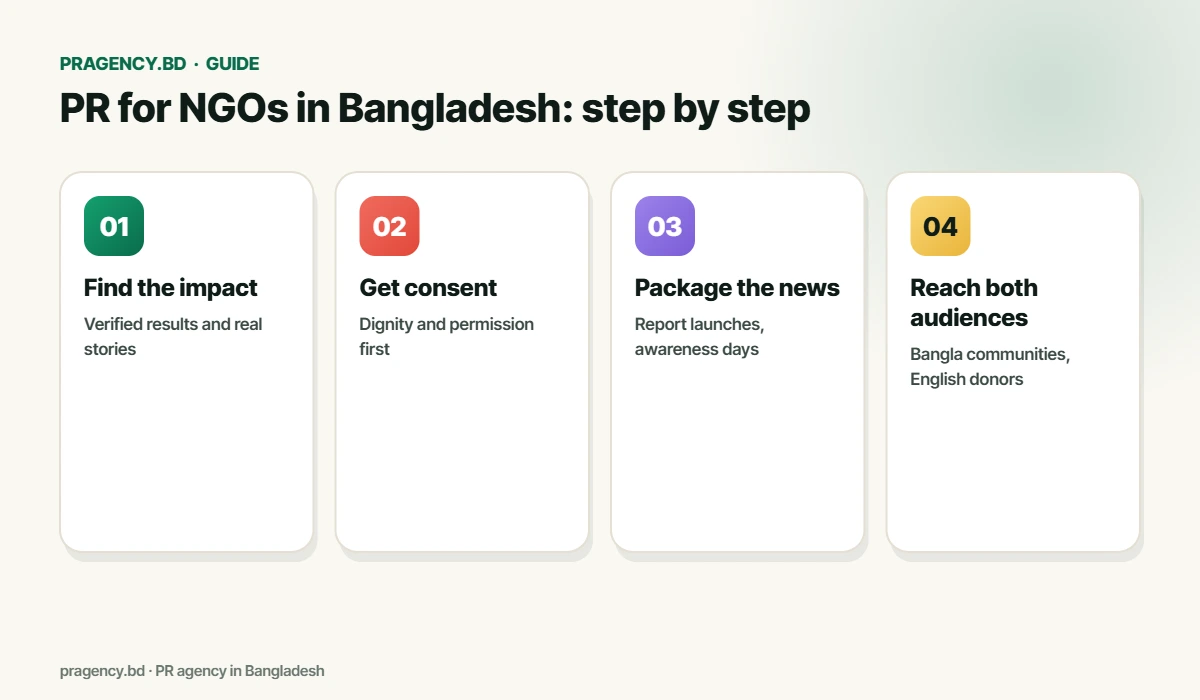
The most important rule in NGO communication is dignity. Avoid images that reduce people to their hardship, always obtain informed consent before featuring someone, and let beneficiaries speak in their own words. Editors and donors increasingly reject “poverty imagery”, and audiences trust stories that respect the people in them.
- Use verified numbers: how many people, which districts, what changed and how it was measured.
- Feature real voices with permission, and protect identities where there is any risk.
- Show the work of local staff and partners, not only the organisation’s leaders.
- Be honest about challenges; it makes success more believable.
Explain where the story will appear, get permission in writing or on record, offer anonymity, and never feature children or survivors without appropriate safeguards.
Turning reports and research into news
Many NGOs produce valuable research that never reaches the public. A report becomes news when it leads with one striking, verified finding, offers an expert for interviews and explains why it matters now. We usually package reports into a press release in Bangla and English, two or three photo cards with key numbers, and an op-ed from the organisation’s leader.
Using awareness days
International and national awareness days give NGOs a natural news hook: World Health Day, International Women’s Day, World Environment Day and many more. Plan stories, data and spokespeople around the days that match your work, weeks in advance.
Press conferences and report launches
For major reports, a well-run press conference can bring national journalists together. Success depends on a clear headline finding, prepared spokespeople, a press kit with data and photos, and follow-up after the event. Our press conference service manages this end to end.
Measuring NGO PR
Track coverage across Bangla and English media, mentions of key findings, partner enquiries after campaigns, and donor feedback. Over time, the goal is a reputation as the trusted source on your issue.
- Media coverage makes real impact visible to donors and partners.
- Dignity and consent come first in every story.
- Lead reports with one verified, striking finding.
- Use Bangla media for communities and English media for donors.
- Plan around awareness days and report launches.
See our PR for NGOs in Bangladesh page for how we help.
A year of NGO communication
Many NGOs communicate only when a report is published or a crisis happens. A simple annual calendar keeps visibility steady.
| Quarter | Focus | Example outputs |
|---|---|---|
| Q1 | Annual results and plans | Impact summary, leader op-ed, donor briefing |
| Q2 | Awareness campaign | Awareness day event, photo cards, local media |
| Q3 | Research or report launch | Press conference, press release in Bangla and English |
| Q4 | Stories of change | Two in-depth features, year-end photo series |
Example: turning a programme into a story
Imagine a programme that trained 1,200 women in tailoring across three districts. The weak version of the story lists training numbers. The strong version follows one woman, with her permission: how she started, what changed for her family, what she earns now, and what challenges remain. Then it adds the programme numbers and a quote from the district coordinator. Editors publish the second version because readers care about people, and donors trust it because the numbers are there too.
Working with journalists respectfully
- Offer access to field locations, with safeguarding rules explained in advance.
- Provide translators and local staff for interviews.
- Share data in simple tables, with sources and dates.
- Respect deadlines; reporters often need answers the same day.
- Accept that journalists may also report challenges; it adds credibility.
Writing an op-ed that gets published
An op-ed by an NGO leader should argue for something specific: a policy change, more funding for an issue, or a new approach. Open with a striking fact, explain the problem, offer two or three concrete recommendations and close with why it matters now. Keep it to 700 to 900 words and avoid promoting the organisation directly; credibility comes from the argument.
Publishing how funds are used, and what did not work, often increases donor confidence more than polished success stories.
Digital channels for NGOs
Facebook news pages and photo cards are effective for awareness campaigns, especially when the message is practical: where to get help, how to register, what to do in an emergency. Combine them with social media PR and photo cards for reach, and keep long-form stories for news features.
Common mistakes
- Using images that strip people of dignity.
- Communicating only to donors in English and ignoring local audiences.
- Burying the main finding of a report on page twelve.
- Waiting for a crisis before building media relationships.
- Claiming results that cannot be verified.
Getting started this month
- Choose one programme with strong, verified results.
- Identify one or two people willing to share their story, with informed consent.
- Prepare a one-page fact sheet with numbers, districts and dates.
- Draft a short release in Bangla and English, and two photo cards.
- Contact two or three journalists who cover development issues.
Small, consistent steps like these build a reputation for credible, respectful storytelling that donors and media remember.
Frequently asked questions
Can small NGOs get media coverage?
Yes, especially with a strong local story, verified numbers and a clear news hook.
Should we pay for coverage?
Earned coverage is more credible. Some sponsored formats are useful for awareness, but they should be clearly labelled.
How do we protect beneficiaries’ privacy?
Get informed consent, offer anonymity and avoid identifying details where there is any risk.
Can you help with international media?
Yes, through our global agency Markertion.
Let Bangladesh see the impact you create
Talk to our Bangladesh PR team about your story, the right media and a realistic plan.
Book a Free 30-Minute PR Consultation or get a quote →