Press release distribution in Bangladesh is not a matter of blasting emails. It is a process of matching a genuinely newsworthy story to the right newsroom at the right moment. Here is exactly how that process works.
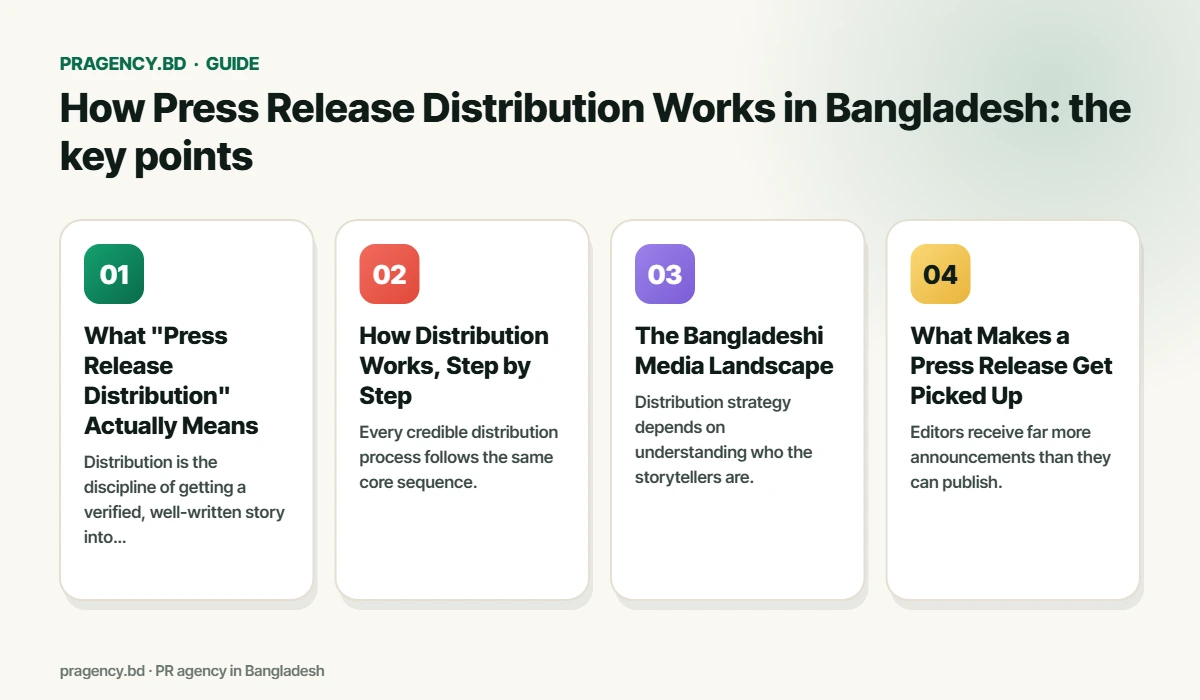
What “Press Release Distribution” Actually Means
Distribution is the discipline of getting a verified, well-written story into the hands of the journalists most likely to cover it.
A press release is a factual announcement written in news style, a company milestone, a product launch, new research, an expansion, a leadership appointment, or a response to a market development. Distribution is everything that happens after the writing: deciding which desks should receive it, delivering it in the format each prefers, following up professionally, and helping journalists who show interest get what they need.
In Bangladesh, distribution also means navigating a bilingual media world. The same announcement may need a Bangla version for Bangla dailies and an English version for the English-language business press, and the angle, tone, and supporting details often differ between the two. Agencies that treat this as a translation job rather than an adaptation job routinely see weaker results.
Done properly, distribution is targeted relationship work. Done poorly, it is spam, and spam burns the very goodwill your brand needs next quarter. Our press release distribution service in Bangladesh is built around the targeted approach.
How Distribution Works, Step by Step
Every credible distribution process follows the same core sequence.
| Step | What happens |
|---|---|
| Step 1: Find the news angle | Before anything is written, the story is stress-tested. |
| Step 2: Write the release in news style | A strong release answers the essential questions up front, who, what, when, where, why, in a headline and lead that a busy editor can assess in seconds. |
| Step 3: Build the media target list | This is where local knowledge pays. |
| Step 4: Pitch and follow up | Releases are delivered with a short, personalized pitch note explaining why the story fits that outlet’s audience. |
| Step 5: Support coverage and report | Once interest appears, the agency coordinates interviews, clarifications, and any embargo timing. |
Step 1: Find the news angle
Before anything is written, the story is stress-tested. Is there something genuinely new here? Who outside the company would care, and why now? An announcement that matters to customers is not automatically news; the angle that makes it relevant to a general or business audience has to be identified first.
Step 2: Write the release in news style
A strong release answers the essential questions up front, who, what, when, where, why, in a headline and lead that a busy editor can assess in seconds. Quotes add human perspective, facts support the claim, and boilerplate describes the company without turning the release into an ad.
Step 3: Build the media target list
This is where local knowledge pays. The target list maps the story to specific desks: business, technology, economy, lifestyle, or industry trade, across print dailies, online portals, and television news. For most Bangladeshi stories, that means a considered mix of Bangla and English outlets rather than one or the other.
Step 4: Pitch and follow up
Releases are delivered with a short, personalized pitch note explaining why the story fits that outlet’s audience. Professional follow-ups answer questions, arrange interviews with company spokespeople, and provide images or data on request, without pressuring or hounding.
Step 5: Support coverage and report
Once interest appears, the agency coordinates interviews, clarifications, and any embargo timing. After publication, placements are collected, classified, and reviewed against the original goals, and lessons feed the next announcement.
The Bangladeshi Media Landscape
Distribution strategy depends on understanding who the storytellers are.
Bangladesh has a dense, competitive media market. The print and online space includes major Bangla dailies such as Prothom Alo, Kaler Kantho, Ittefaq and Jugantor, alongside newer digital-native outlets like Bangla Tribune and bdnews24, while The Daily Star and Dhaka Tribune anchor much of the English-language business conversation. Television is equally influential: channels such as Jamuna TV, Ekattor, Somoy TV, Channel i, NTV and ATN Bangla run news cycles where a well-timed business segment can reach millions.
These names illustrate the landscape, where stories get told and who tells them, rather than any commercial relationship. What matters for your campaign is the pattern behind them: different outlets serve different audiences in different formats. A story that fits a business-desk feature in an English daily may work better as a short TV news item or a Bangla portal story depending on the subject.
Timing matters too. Newsroom workloads, weekly publication rhythms, and the daily news cycle all influence when a pitch lands well. Experienced distributors pitch with the calendar in mind, avoiding moments when your announcement would be drowned out by bigger national stories, and choosing windows when your sector is actively in the news.
What Makes a Press Release Get Picked Up
Editors receive far more announcements than they can publish. The ones that survive share common traits.
Clear relevance to a broad audience
Stories that connect to everyday life, the national economy, jobs, consumer prices, technology adoption, or public interest move to the front of the queue. A new service launch framed around what it changes for Bangladeshi users is news; the same launch framed around how proud the company is, is not.
Hard facts and credible specifics
Announcements with concrete, verifiable details, what launched, where it operates, who it serves, what problem it solves, are easier to trust and easier to write about. Vague claims and unsupportable superlatives make editors cautious, as they should.
A spokesperson worth quoting
Offering an articulate spokesperson, a founder, CEO, or subject-matter expert, for follow-up questions turns a static announcement into a story with a voice. For Bangladeshi business coverage, a leader who can speak clearly about the market behind the news dramatically raises the odds of in-depth features.
Clean, ready-to-use materials
High-resolution images, concise fact sheets, and well-organized background information make an editor’s job easier. Every barrier between interest and publication is a chance for the story to be dropped.
Common Mistakes That Get Releases Ignored
Most distribution failures are self-inflicted and entirely avoidable.
- Writing an advertisement. Superlatives, slogans, and unearned claims read as marketing and get deleted. News style is factual and restrained.
- Blasting every contact. Sending one generic email to an entire contact list trains journalists to ignore you. Targeting is not optional.
- Announcing non-news. Internal milestones that matter greatly inside a company often have no external news value. A good agency will tell you this honestly before a release is written.
- Ignoring language nuance. A stiff, literally translated Bangla release signals that the story was not crafted for that audience, because it wasn’t.
- Bad timing. Pitching during a major national news event guarantees your story is overlooked, no matter how good it is.
What Happens After the Story Runs
Publication is not the finish line, it is the start of the return on your PR work.
Coverage in established publications builds credibility that paid advertising cannot replicate: a journalist or editor judged your story worth telling. That third-party validation shapes how customers, partners, and future employees perceive your brand, and it persists as a permanent reference point.
Coverage also compounds digitally. Published stories on reputable news sites create news backlinks that strengthen your brand’s visibility in search results, and each feature becomes evidence that makes the next story easier to place. Tracking placements, studying which angles performed best, and feeding those lessons into your next announcement is how one-off distribution turns into sustained media presence. For how this fits into a broader plan, see our PR guides on the blog, or review distribution pricing to scope a first campaign.
Frequently Asked Questions
How is press release distribution different from paid advertising?
Advertising buys guaranteed space in a chosen format. Distribution pitches your story to newsrooms, where editors decide independently whether it runs. Coverage earned this way carries editorial credibility; audiences read it as news, not as an ad.
Should a press release be written in Bangla or English?
Often both, and adapted rather than translated. Bangla dailies and Bangla news portals reach the widest local audiences, while the English-language business press covers corporate and economic stories for a different readership. The angle should be tuned to each.
How long does distribution usually take?
Writing and targeting typically take a few days; pitching and follow-up play out over one to two weeks depending on the news cycle. Feature stories and TV segments may take longer to coordinate than short news mentions.
Can I pay to guarantee a publication?
Any guaranteed placement is paid media, not PR, and reputable agencies keep those categories separate. The value of earned coverage comes precisely from the fact that a newsroom chose to run it.
What should I provide to start a distribution campaign?
The core facts of your announcement, access to a spokesperson for interviews, any supporting data or images, and clarity on your goals. A good agency handles the angle-finding, writing, targeting, and pitching from there.
Have an Announcement Worth Covering?
Tell us the story you want to tell. In a free 30-minute consultation, we will assess its news angle, map the right media targets in Bangladesh, and outline a distribution approach that fits your goals.
Book a Free 30-Minute PR Consultation or get a quote →