Corporate PR for industrial groups in Bangladesh manages the reputation of a business group, its many companies and its leaders: consistent group messaging, chairman and director profiles, investment and export news, CSR and ESG stories, and a prepared crisis plan.
Why large groups need a different kind of PR
Bangladesh’s large business groups span steel, cement, electronics, real estate, textiles, food, media and more. A single group may run dozens of companies and brands. That scale creates opportunity and risk: one company’s success lifts the group, and one company’s crisis can damage all of them.
Corporate PR for these groups is less about individual product launches and more about the group’s reputation as a whole, how it is seen by government, banks, investors, employees, buyers and the public.
The pillars of corporate PR
| Pillar | What it covers | Why it matters |
|---|---|---|
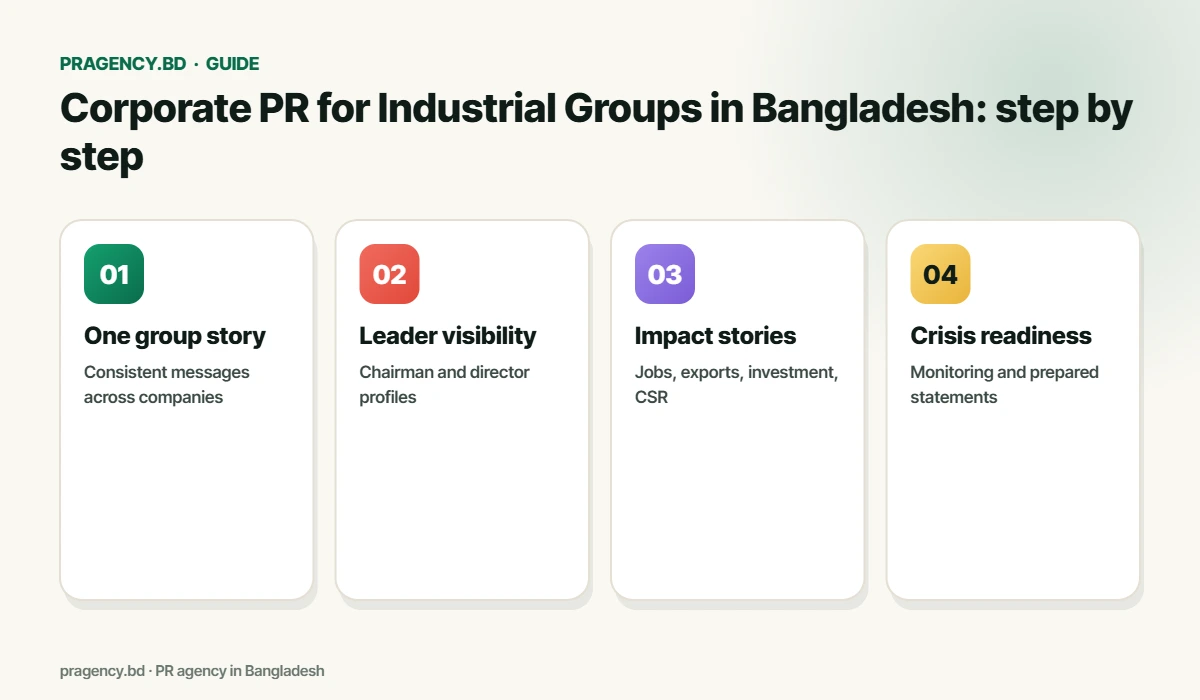
| Group narrative | Who the group is, its values and contribution | Consistency across many companies |
| Leadership profiles | Chairman, MD and directors | Leaders are the face of the group |
| Impact communication | Jobs, exports, investment, tax | Shows contribution to the economy |
| CSR & ESG | Community, environment, governance | Expected by buyers, banks and investors |
| Crisis readiness | Monitoring, statements, spokespeople | Protects the reputation when issues arise |
One voice for many companies
Groups with many sister concerns need clear rules: who speaks for the group, how each company is described, how news is approved and how brand identities relate to the group. Without these rules, journalists receive mixed messages and the group’s story becomes fragmented.
- Create a group fact sheet with consistent numbers: employees, companies, exports, founding year.
- Name official spokespeople for the group and for each major company.
- Set an approval process for press releases and interviews.
- Keep a central record of all coverage across companies.
Leaders as national voices
Chairmen and directors of large groups are natural commentators on industry, exports, investment and the economy. Well-prepared interviews, op-eds and TV appearances strengthen both the leader and the group. See our CEO branding service.

Communicating impact
Large groups contribute jobs, exports and investment. That story is rarely told well. Clear, verified numbers, factory stories, employee voices and community programmes help the public and policy makers understand the group’s contribution.
Crisis readiness
Industrial groups face predictable risks: factory incidents, labour disputes, supply problems, regulatory issues and rumours on social media. Preparation makes the difference.
- Monitor news and social media for early warning signs.
- Prepare holding statements for the most likely scenarios.
- Train spokespeople to answer difficult questions calmly.
- Agree who approves statements and how fast.
- After the crisis, communicate what changed.
In a crisis, the first few hours matter. A short, accurate holding statement is better than silence or speculation.
Reaching international audiences
Export-oriented groups also need visibility with international buyers and investors. Through our global agency Markertion, Bangladeshi groups can extend their stories to international business media.
- Group reputation is bigger than any single company.
- Consistent facts and clear spokespeople prevent mixed messages.
- Leaders are the face of the group.
- Tell the impact story with verified numbers.
- Prepare for crises before they happen.
Explore our corporate PR for industrial groups.
Example: a group factory expansion
A business group opens a new factory that will create 2,000 jobs. The weak announcement is a photo of a ribbon cutting. The strong version includes:
- A press release with the investment amount, jobs created, products and export markets.
- Interviews with the chairman on the group’s long-term plans for the sector.
- A feature following a few new employees, with their permission, from training to first salary.
- Photo cards highlighting the jobs and local impact.
- An English-language story for international buyers and investors.
This approach shows the group’s contribution to the economy, not just its size.
Group messaging framework
| Level | Message focus | Spokesperson |
|---|---|---|
| Group | Vision, values, contribution to Bangladesh | Chairman or group MD |
| Company | Products, growth, customers | Company MD or CEO |
| Brand | Consumer benefits, campaigns | Marketing head |
| Crisis | Facts, actions, timeline | One designated spokesperson |
ESG and sustainability communication
International buyers, banks and investors increasingly ask about environmental, social and governance practices. Communicate certifications, energy and water savings, worker welfare programmes and governance improvements with documentation. Avoid vague claims like “eco-friendly”; specific, verifiable facts build credibility and protect against accusations of greenwashing.
Every ESG claim should be backed by a certificate, audit, report or data you can share with a journalist who asks.
Managing many brands without confusion
- Keep a central media calendar so companies do not announce on the same day.
- Share a coverage report across companies each month.
- Use the group name consistently in boilerplates.
- Train company spokespeople on group-level topics they should redirect.
Working with business journalists
Business desks value access, data and honesty. Offering background briefings, annual results in a clear format and access to leaders for comment builds relationships that matter when difficult stories arise.
Common mistakes
- Communicating only through advertisements in newspapers.
- Letting each company speak about group matters independently.
- Making ESG claims without evidence.
- Ignoring social media until a rumour goes viral.
- Treating PR as a one-off event instead of a long-term reputation programme.
Measuring corporate reputation
Track share of voice in business media, tone of coverage, leaders’ visibility, enquiries from partners and buyers, and how the group is described in independent articles. These measures show whether the group’s story is being understood.
Getting started this month
You do not need a huge budget to improve a group’s reputation. Start with the basics that most groups skip.
- Write a one-page group fact sheet with verified numbers: companies, employees, export markets, founding year and leadership.
- Search the group and each leader’s name on Google and list what appears on the first page.
- Name one group spokesperson and one backup, and agree an approval process that works within an hour.
- Pick two genuine stories from the last year, such as a new factory, an export milestone or a community programme, and turn them into features with photos and numbers.
- Draft holding statements for your three most likely crisis scenarios.
- Book a briefing with two or three business journalists to introduce the group, without asking for coverage.
These steps take a few weeks and create the foundation for everything else: consistent facts, prepared people and a pipeline of real stories. From there, a quarterly plan of leadership interviews, impact features and ESG communication keeps the group visible for the right reasons. Groups that want help with this foundation can start with a free consultation with our team.
Frequently asked questions
Do you work with very large groups?
Yes. Plans are scaled to the number of companies and leaders.
Can you manage PR for several sister concerns?
Yes, with a central plan and company-level stories.
How confidential is the work?
We work under confidentiality and never publicise clients without consent.
Can you help after a crisis has started?
Yes, with fast statements, media handling and recovery communication.
Protect and grow your group’s reputation
Talk to our Bangladesh PR team about your story, the right media and a realistic plan.
Book a Free 30-Minute PR Consultation or get a quote →