Print, television, online news, social platforms, Bangladeshi businesses now face more media choices than ever. Here is how traditional and digital PR differ, overlap, and combine into a mix that actually works.
Two PR Worlds, One Goal
Public relations in Bangladesh has always been built on one idea: earn attention through credibility rather than buy it. What has changed is where that attention lives.
A generation ago, PR here largely meant getting a story into a national daily or a mention on a television bulletin. Today, the same announcement can appear in the business pages of Prothom Alo or The Daily Star, surface on digital news portals within minutes, circulate through LinkedIn and Facebook, and shape search results for years. Audiences move between these channels constantly, a reader might discover a story on social media, verify it on a news site, and later recall it from a TV segment.
So the question facing most businesses, a garment exporter in Chattogram, a fintech startup in Gulshan, a hospital group opening a new branch, is not really “traditional or digital?” It is “which combination serves our goals, audiences and budget?” This article breaks the decision down piece by piece.
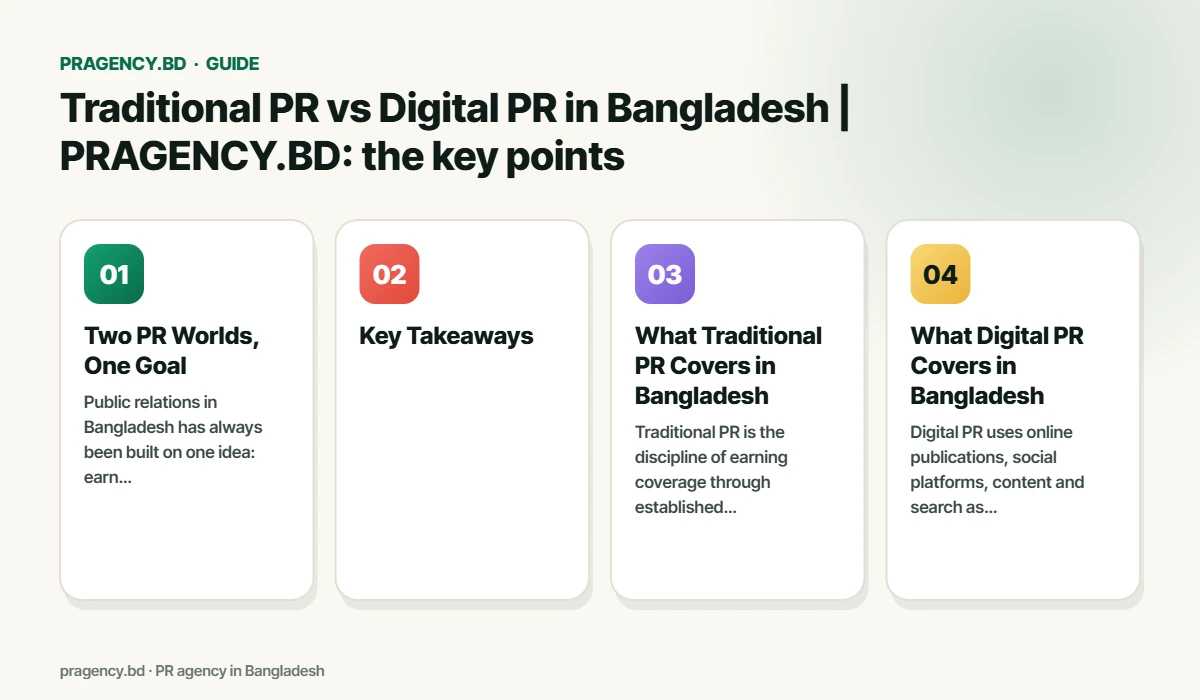
Key Takeaways
| Point | What it means for your brand |
|---|---|
| Traditional PR Builds Deep Trust | Coverage in established dailies and on television carries strong third-party credibility, especially with corporate, institutional and older audiences in Bangladesh. |
| Digital PR Builds Speed and Reach | Online coverage, social amplification and search visibility make digital PR faster to deploy, easier to measure and more adaptable to shifting news cycles. |
| The Lines Are Blurring | Most major Bangladeshi outlets now publish online, so a single strong story can deliver both traditional credibility and digital reach at once. |
| Mix Matters More Than Camp | The right balance depends on your audience, goals and timeline, not on ideology. Most businesses benefit from a deliberate combination. |
What Traditional PR Covers in Bangladesh
Traditional PR is the discipline of earning coverage through established media: newspapers, magazines, television and radio.
Where it shows up
In practice, that means business-page features in Bangla and English dailies such as Ittefaq, Jugantor, Kaler Kantho and Dhaka Tribune, interview segments and talk show discussions on channels like Jamuna TV, Ekattor, Somoy TV, Channel i and NTV, and coverage of press conferences and corporate events. These are neutral examples of the outlets that make up the landscape, the point is the format, not any particular relationship.
Why it still carries weight
- Editorial gatekeeping: because newsrooms choose what to publish, appearing there signals independent validation. Nobody assumes a newspaper feature was paid for.
- Broad and layered audiences: television and mass-circulation dailies reach people across age groups, income levels and regions, including decision-makers who never describe themselves as “online”.
- Authority that transfers: a strong broadcast interview or print feature becomes a credential, for investors, partners, regulators and senior hires, that keeps working long after publication.
- Crisis and reputation value: in difficult moments, being covered by trusted institutions matters far more than follower counts.
The trade-offs are real: traditional coverage is slower to arrange, harder to guarantee, and difficult to measure precisely. For launches and campaigns where broadcast matters, formats like TV and show coverage make the preparation far more deliberate.
What Digital PR Covers in Bangladesh
Digital PR uses online publications, social platforms, content and search as its raw material, with measurability as its defining advantage.
Where it shows up
Online news portals and digital editions of major papers, industry blogs and niche publications, LinkedIn and Facebook commentary, contributed articles, and content designed to earn mentions and links across the web. For a market where mobile internet is the primary gateway to information for most people, this is where mass digital audiences actually form their opinions.
Why it earns its place in the mix
- Speed: a story can go from approved to published and circulating within hours, invaluable when responding to a live trend or issue.
- Targeting: digital channels reach specific professional, demographic and interest groups far more precisely than broadcast.
- Measurability: traffic, engagement, mentions and search impact can be tracked, which makes optimisation, and honest reporting, possible.
- Durability: online coverage keeps working through search. A well-placed feature can keep surfacing to potential clients for years.
Structured digital campaigns, see our digital PR campaign approach, combine these elements into a planned effort rather than scattered posting.
Where the Two Overlap, and Where They Diverge
Treating traditional and digital PR as opposites is a mistake; in Bangladesh they increasingly feed each other.
| Point | What it means for your brand |
|---|---|
| Speed vs Depth | Digital wins on turnaround and adaptability; traditional wins on the depth of attention a feature or interview commands from its audience. |
| Reach vs Precision | Television and major dailies deliver sheer scale; digital channels deliver narrower, better-matched audiences, and can scale when content resonates. |
| Trust vs Traceability | Traditional coverage is harder to measure but rarely questioned; digital coverage is fully trackable but must be earned on platforms where content volume is enormous. |
| Convergence Is Real | Major outlets publish across print, web and video, so one well-placed story increasingly delivers both kinds of value. The mix, not the label, decides the outcome. |
| Different Roles in the Funnel | Traditional coverage often opens doors and establishes status; digital coverage supports discovery, consideration and direct response along the way. |
| Cost Structures Differ | Traditional work concentrates spend in strategy, relationships and production; digital work spreads across content, distribution and ongoing optimisation. |
The practical implication: a modern PR budget in Bangladesh rarely belongs entirely in one camp. Even heavily digital strategies gain from the credibility anchor of earned print or broadcast coverage, and traditional campaigns perform better when their coverage is amplified and preserved online.
Choosing the Right Mix for Your Business
The right blend depends on four practical questions about your business.
Who Needs to Trust You?
If your buyers are corporate procurement teams, investors or institutional partners, traditional business media and leadership profiles carry disproportionate weight. If your audience discovers brands through feeds and search, digital coverage leads.
What Is the Timeline?
Product launches tied to retail seasons need visibility fast, which favours digital speed with traditional amplification. Reputation-building for a listed company or a financial institution is a longer game where established media matters most.
What Does Success Look Like?
Credibility with decision-makers points toward earned features and interviews. Traffic, leads and search visibility point toward digital campaigns. Most businesses need both, weighed differently.
What Can You Sustain?
A modest, consistent programme across both worlds beats an ambitious one-off. Choose a mix your team, or your agency, can maintain for quarters, not just weeks.
For many Bangladeshi businesses the answer that emerges is familiar: anchor credibility with traditional coverage, extend it through digital channels, and tie both to clear commercial goals. Services like news backlinks illustrate the overlap directly, news coverage that also builds lasting digital authority.
Frequently Asked Questions
Is traditional PR still worth it in Bangladesh?
Yes. Established newspapers and television remain the most trusted media sources for large parts of the population and for corporate decision-makers. The credibility of independent editorial coverage is difficult to replicate on any other channel, which is exactly why it still anchors most serious PR programmes.
Can digital PR replace traditional PR entirely?
For some goals, direct traffic, search visibility, fast-moving consumer audiences, digital can carry a campaign on its own. But for institutional credibility, crisis situations and senior stakeholder audiences, traditional coverage does work digital cannot easily do. Most businesses are best served by both.
Which is easier to measure?
Digital PR is more directly measurable: traffic, engagement, mentions and search performance can all be tracked. Traditional PR measurement is more qualitative, outlet prominence, message pull-through, audience type and stakeholder response, but this does not make it less valuable, only differently valuable.
We are a small business with a limited budget. Where should we start?
Start where your audience actually is, and favour consistency over scale. A focused digital presence plus one or two credible earned placements per quarter is a realistic beginning. From there, results should guide how the mix expands, not the other way around.
How do social media PR and news coverage relate to each other?
They reinforce each other. News coverage gives your social content authority and something substantive to share, while social channels extend the reach and lifespan of that coverage. Treating them as one continuous system is how modern campaigns get the most from every story.
Build a PR Mix That Fits Your Market, Not a Template
PRAGENCY.BD plans and runs PR programmes across both traditional and digital channels for businesses throughout Bangladesh, from single announcements to sustained campaigns. Bring us your goals and we will map the mix that fits. You can also explore more practical PR guides on our blog, including how campaign budgets compare on our press release pricing page.
Book a Free 30-Minute PR Consultation or get a quote →