A Bangladeshi company or person can have a Wikipedia article only if they are notable: covered in depth by multiple reliable sources that are independent of them, such as established newspapers, magazines or books. Press releases and sponsored content do not count. Paid help is allowed only with disclosure, and nobody can guarantee acceptance.
Why everyone wants a Wikipedia page
Wikipedia is one of the most trusted sources on the internet. Google uses it for knowledge panels, AI assistants rely on it to describe people and companies, and journalists check it for quick facts. For a Bangladeshi brand or leader, a Wikipedia article signals that independent sources consider them significant.
That is exactly why Wikipedia is strict. Its volunteer editors protect the encyclopaedia from promotion, so the rules focus on independent evidence rather than what a company says about itself.
The notability test
Wikipedia’s general rule is simple to state and hard to meet: a subject is notable when it has received significant coverage in reliable sources that are independent of the subject.
| Usually counts | Usually does not count |
|---|---|
| In-depth articles in established newspapers and magazines | Press releases and articles based on them |
| Respected industry publications with editorial oversight | Sponsored, paid or “partner” content |
| Books and academic work that discuss you in detail | Your own website, blog and social media |
| Multiple independent sources over time | Directory listings and brief mentions |
Paid placements and press release pickups are useful for PR and SEO, but Wikipedia editors generally discount them for notability. Plan your coverage with that in mind.
The honest process
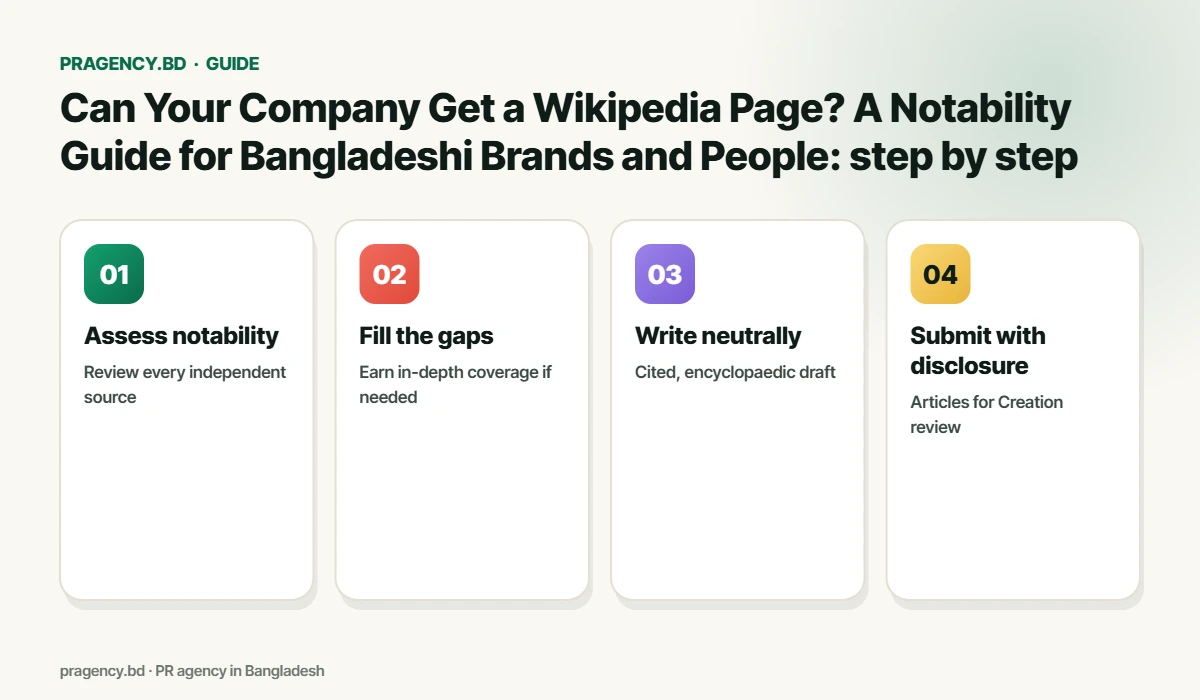
Step 1: assess notability source by source
Before writing anything, list every article about you and judge each one: is it independent, reliable and in-depth? The result is one of three answers: ready now, nearly there, or not yet.
Step 2: fill the gaps with real coverage
If you are not notable yet, the path is not clever writing; it is earning genuine coverage. In-depth news features, interviews and profiles in established Bangladeshi publications, gained on merit, build the foundation.
Step 3: write a neutral, well-cited draft
A Wikipedia article is not a company profile. It uses neutral language, avoids praise, and cites a reliable source for every significant claim. Controversies that appear in reliable sources may also belong in the article.
Step 4: submit with disclosure
Wikipedia’s terms require paid contributors to disclose their paid status, and its conflict-of-interest guideline asks them to submit drafts through Articles for Creation rather than publishing directly. Volunteer reviewers then accept, request changes or decline.
Bangla Wikipedia or English Wikipedia?
Each language edition has its own community and standards. English Wikipedia usually expects stronger sourcing. Bangla Wikipedia can be appropriate when most coverage about you is in Bangla. The decision should follow your sources, not your preference.
What happens after publication
Wikipedia articles belong to the community. Anyone can edit them, and you should not edit your own article directly. If something is wrong, the right approach is a disclosed edit request on the article’s talk page with a reliable source.
- Notability needs in-depth coverage from multiple independent, reliable sources.
- Press releases, sponsored posts and your own channels do not count.
- Paid help must be disclosed and drafts should go through review.
- If you are not notable yet, earn coverage first.
- Nobody can honestly guarantee acceptance.
Wikipedia and Google Knowledge Panels
A Wikipedia article is one of the strongest sources for a Google Knowledge Panel, but it is not required. Many brands get panels through consistent profiles, structured data and trusted news coverage. See our Google Knowledge Panel guide.
Learn how our Wikipedia page creation service works.
Example: assessing a Bangladeshi company’s sources
Imagine a fast-growing Dhaka e-commerce company asks whether it qualifies for Wikipedia. Its coverage includes:
| Source | Type | Counts toward notability? |
|---|---|---|
| Twenty news portal articles based on its press releases | Press release pickups | Usually no |
| A sponsored feature in a business magazine | Paid content | No |
| A 1,500-word investigative feature in a national daily about its growth and controversies | Independent, in-depth | Likely yes |
| An academic paper on e-commerce in Bangladesh that discusses it in a section | Independent, in-depth | Likely yes |
| Its own blog, Facebook page and founder interviews on its YouTube channel | Self-published | No |
The honest verdict here is “nearly there”. Two strong independent sources exist; a third or fourth in-depth, independent article would make a much stronger case.
Writing like an encyclopaedia, not a brochure
Wikipedia articles use a neutral point of view. Compare these two sentences:
- Brochure: “XYZ is Bangladesh’s leading and most innovative e-commerce platform, loved by millions.”
- Encyclopaedic: “XYZ is a Bangladeshi e-commerce company founded in 2019 and headquartered in Dhaka.[1]”
Every important claim needs a citation to a reliable source, and claims like “leading” or “best” usually do not belong at all.
The structure of a typical company article
- Lead section: what the company is, where it is based, when it was founded.
- History: key events in chronological order, each cited.
- Operations or services: neutral description of what it does.
- Reception or controversies: if covered by reliable sources.
- References: a list of the independent sources used.
If you are connected to the subject, you should not edit the article directly. Use the talk page to request changes, with sources, and disclose your connection.
Common reasons drafts are declined
- Sources are mainly press releases or promotional articles.
- The tone reads like marketing.
- Coverage is only local or only routine announcements.
- The subject is “too soon”: real but not yet widely covered.
- Paid involvement was not disclosed.
Building toward notability the right way
If your verdict is “not yet”, focus on work that genuinely interests journalists: original research, significant milestones, community impact or a founder story with substance. Earn in-depth news features and interviews on merit over time. When the independent coverage exists, the Wikipedia question answers itself, and the same coverage strengthens your Google Knowledge Panel.
Getting started this month
List every article ever written about your company or leader, mark each as independent or not, in-depth or not, and reliable or not. Be strict. That list tells you more than any sales pitch about whether a Wikipedia article is realistic today, and it shows exactly what kind of coverage you still need.
Frequently asked questions
Can you guarantee a Wikipedia page?
No. Volunteer editors decide. Anyone guaranteeing acceptance is not following Wikipedia’s rules.
Does a Wikipedia link help SEO?
Wikipedia links are nofollow. The value is trust: Google and AI assistants use Wikipedia to understand who you are.
Can I write my own Wikipedia article?
You can submit a draft with conflict-of-interest disclosure, but neutral writing about yourself is very hard. Independent sources matter more.
What if my article gets deleted?
Usually that means notability was not shown. The fix is more in-depth independent coverage, not rewriting.
Find out honestly if you qualify for Wikipedia
Talk to our Bangladesh PR team about your story, the right media and a realistic plan.
Book a Free 30-Minute PR Consultation or get a quote →