Political PR in Bangladesh means helping leaders and candidates explain their work and positions clearly through news media, TV and Facebook news pages, using verified facts and staying within the law. Good political PR builds familiarity and trust; it never relies on misinformation or attacks.
What political PR actually is in Bangladesh
Political PR is the work of communicating a leader’s public service, ideas and character to the people they serve. In Bangladesh that audience reads local and national news, watches TV talk shows and, above all, scrolls Facebook. A representative who builds a road, runs a health camp or speaks in parliament only gets credit for it if people hear about it in a format they trust.
That is the core difference between political PR and political advertising. Advertising says “vote for me”. PR shows what someone has done, lets journalists and the public judge it, and builds familiarity over months and years rather than days.
PRAGENCY.BD is non-partisan. We work only on factual, ethical communication and never produce misinformation, deepfakes or attack content against opponents.
Who uses political PR
- Members of parliament and ward or union representatives who want their constituency work to be visible.
- Candidates preparing for local or national elections.
- Party office-bearers and spokespeople who appear on TV and in the press.
- Mayors, councillors and public officials who need to explain projects and policies.
- Advisors, policy experts and civil society leaders who comment on public issues.
The channels that matter
Political audiences in Bangladesh are reached through a mix of channels, and each needs a different format.
| Channel | What works | Watch out for |
|---|---|---|
| Local news portals & dailies | Constituency projects, development stories with numbers | Exaggerated claims that reporters cannot verify |
| National dailies | Policy positions, interviews, op-eds | Sending generic press releases with no news angle |
| TV talk shows | Clear positions, calm debate, prepared talking points | Unprepared answers and personal attacks |
| Facebook news pages | Photo cards, short videos, milestone posts | Fake engagement or misleading visuals |
| Your own page | Daily updates, community events | Posting without a clear message plan |
Step by step: building a political PR plan
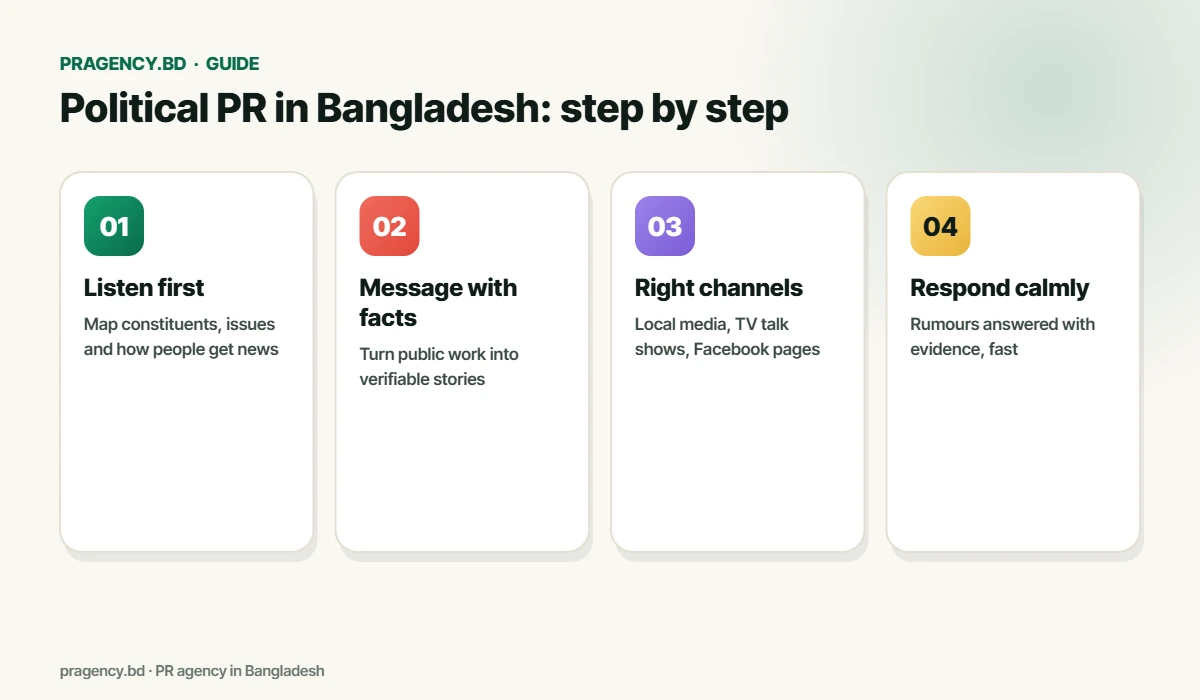
1. Listen before you speak
Start with the people. What do constituents care about this year: jobs, roads, prices, health, education? Which media do they actually use? A short listening phase, through local meetings, conversations with journalists and a review of comments on local pages, prevents a plan built on assumptions.
2. Turn public work into verifiable stories
Every project should become a story with facts: what was built, for how many people, at what cost, with what result. Reporters trust numbers they can check, and so do voters. Photos with captions, quotes from beneficiaries and before-and-after images make a story credible.
3. Choose the right spokespeople and formats
Not every message should come from the leader directly. Local beneficiaries, doctors at a health camp or teachers at a renovated school are often more convincing. For TV, prepare three clear points and two examples; for photo cards, one sentence and one strong image.
4. Respond to rumours with evidence
Rumours spread fast on Facebook. The best response is quick, calm and factual: a short statement, supporting documents or photos, and an offer to answer journalists’ questions. Silence lets a rumour harden; anger makes it a story.
Ethics and the law
Political communication in Bangladesh happens under Election Commission rules on campaigning, spending and conduct, and under laws on defamation and digital content. A responsible PR team keeps you inside those lines.
- Label sponsored content where required and keep records of spending during election periods.
- Never fabricate quotes, statistics, photos or endorsements.
- Do not create or share deepfakes or manipulated images of anyone.
- Avoid personal attacks; contrast policies and records instead.
- Respect the privacy and consent of people who appear in your stories.
- Political PR shows public work; it does not shout slogans.
- Facts, photos and beneficiaries’ voices make stories believable.
- Facebook news pages and TV talk shows reach most voters.
- Answer rumours fast, calmly and with evidence.
- Stay inside Election Commission rules and never use misinformation.
How photo cards help political communication
A photo card turns one achievement into one shareable image: a headline, a photo and a source line. For a representative, a series of photo cards can document a year of work in a way people actually read and share. Our photo card service designs them in Bangla and English, and our social media PR team can place them on relevant news pages.
TV talk shows: preparation matters
Bangladeshi talk shows reward clarity. Before an appearance, prepare three messages, two examples with numbers and calm answers to the toughest likely question. Watch previous episodes of the programme to understand the host’s style. Our TV PR service includes on-camera briefing for spokespeople.
Measuring political PR
Good measurement looks beyond likes. Track coverage in local and national media, the tone of that coverage, how often your name appears with your key issues, and how people describe you in comments and community meetings. Over time, the goal is simple: people should know what you have done and what you stand for.
Learn more on our political PR in Bangladesh page.
A 90-day political communication plan
A plan turns good intentions into steady visibility. The 90 days below assume a sitting representative or a candidate preparing well ahead of an election period.
| Period | Focus | Typical outputs |
|---|---|---|
| Days 1 to 15 | Listening and audit | Issue list, media map, review of current coverage and comments |
| Days 16 to 45 | Public work stories | Three development stories with photos, numbers and local voices |
| Days 46 to 60 | Media relations | Interviews with local and national reporters, one op-ed |
| Days 61 to 75 | TV and debate | One talk show appearance with briefing and practice |
| Days 76 to 90 | Review and reset | Coverage report, comment analysis, next quarter’s priorities |
Local media matters more than many leaders think
National headlines feel important, but voters often trust local news portals, district correspondents and community pages more. A correspondent who knows the area can explain why a new bridge or school matters in a way a national story cannot. Building respectful relationships with local journalists, answering their questions and giving them access to facts, is one of the most effective investments a representative can make.
How to write a development story that gets published
- Start with the people affected: “Three thousand families in … now reach the upazila hospital in twenty minutes instead of an hour.”
- Give the facts a reporter can check: project cost, funding source, completion date, responsible agency.
- Add two voices: a beneficiary and an official or engineer.
- Provide three good photos with captions, taken by someone who knows how to frame people respectfully.
- Avoid claiming sole credit where many people contributed; reporters notice and readers resent it.
Handling difficult interviews
Every public figure faces hostile questions. Preparation turns them into an opportunity. Write down the ten hardest questions you could be asked, draft honest short answers, and practise saying them calmly. If you do not know an answer, say you will find out and follow up. A calm “I will check those figures and come back to you” is far better than a confident wrong number.
Most voters consume political news in Bangla. Write and rehearse your key messages in natural Bangla first, then adapt them for English media and diplomatic audiences.
Common mistakes in political communication
- Posting only photos of meetings and ribbon cuttings with no explanation of results.
- Using paid “likes” or fake accounts, which journalists and opponents expose quickly.
- Answering criticism with personal attacks instead of facts.
- Changing positions without explaining why.
- Ignoring young voters who mainly use short video and Facebook news pages.
What success looks like
After six to twelve months of consistent, ethical communication, people in the constituency should be able to name at least two concrete things the leader has done, local journalists should know whom to call for comment, and rumours should be answered within hours with evidence. That is the foundation of public trust, and it is built one honest story at a time.
Frequently asked questions
Is political PR legal in Bangladesh?
Yes. Communicating a leader’s work and positions through media is legal, as long as it follows Election Commission rules and laws on defamation and digital content.
Do you work for any political party?
No. PRAGENCY.BD is non-partisan and works only on ethical, fact-based communication.
Can you get a leader on TV talk shows?
We pitch relevant programmes and prepare spokespeople; editorial decisions always rest with the channel.
How do you handle false rumours?
With a fast, factual statement, supporting evidence and media relations, never with counter-misinformation.
Communicate your public work clearly and ethically
Talk to our Bangladesh PR team about your story, the right media and a realistic plan.
Book a Free 30-Minute PR Consultation or get a quote →